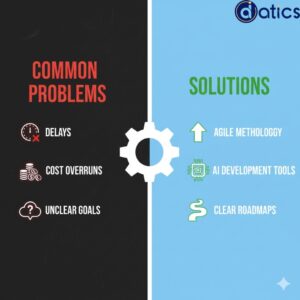
Software product development is the backbone of modern businesses, but it rarely comes without challenges. From unclear requirements to rising costs and missed deadlines, many organizations struggle to turn ideas into successful, scalable products. Understanding these problems—and learning how to solve them—can mean the difference between a failed launch and a product that drives real business value.
In this blog, we’ll break down the biggest problems in software product development and explore practical solutions that help companies deliver faster, smarter, and more efficiently.
One of the most common problems in software product development is a lack of clarity around product goals. Teams often begin coding without a well-defined roadmap, leading to scope creep, endless revisions, and wasted resources.
How to Fix It:
Clarity at the start ensures that every decision made during development aligns with business objectives.
In product development, collaboration between design, engineering, marketing, and stakeholders is crucial. A lack of communication can lead to misunderstandings, missed deadlines, and inconsistent features.
When communication flows freely, software development becomes smoother and faster.
Budget overruns are a nightmare for startups and enterprises alike. Costs often spiral when projects drag on, new features are added last-minute, or the scope keeps expanding.
Companies that focus on cost control without cutting quality build sustainable and scalable products.
With competition growing daily, delays in launching can mean losing your advantage. Traditional development models are often too slow to keep up with customer demands.
Adopting modern practices like Software Product Development ensures speed without sacrificing quality.
Many businesses launch products that cannot handle growth. When software fails to scale, it limits revenue potential and frustrates users.
Scalable products grow with your business rather than holding it back.
Another growing issue is the gap between traditional software development models and modern approaches like AI-driven development. Traditional methods often take longer and lack flexibility, while AI-powered strategies accelerate innovation.
Adopt hybrid approaches that bring together the reliability of traditional frameworks with the efficiency of AI-driven tools. For more insights, you can explore our in-depth blog: AI Product Development vs. Traditional MethodsThis balance ensures companies get the best of both worlds—speed and reliability.
The biggest challenge is often unclear requirements, which cause delays and unnecessary costs.
Using MVP strategies, Agile frameworks, and AI-driven automation helps cut costs significantly.
Most products fail to scale because scalability wasn’t considered during the design stage.
AI enhances speed, accuracy, and automation in areas like testing, coding, and decision-making.
Prioritizing essential features, using Agile sprints, and leveraging AI tools accelerates time-to-market.