

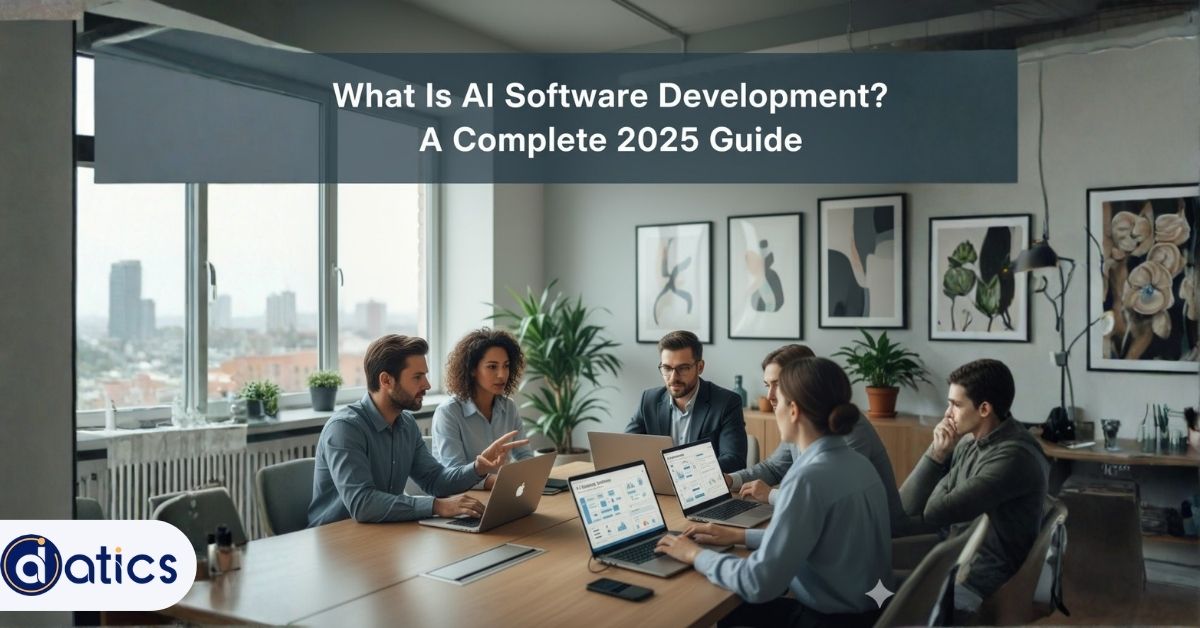
Artificial Intelligence (AI) is no longer an experimental concept—it’s the foundation of modern business transformation. In 2025, companies across every industry are leveraging AI Software Development to automate decisions, streamline processes, and discover insights hidden in massive data streams.
This guide breaks down what AI software development really means, how it differs from traditional coding, and why it’s become a critical driver of innovation for businesses worldwide.
Understanding AI Software Development
AI software development is the process of designing, building, and deploying software systems that can learn from data and make intelligent decisions. Unlike traditional software, which follows predefined instructions, AI systems adapt over time based on new information.
In simpler terms, it’s about creating software that thinks—identifying patterns, predicting outcomes, and improving automatically without human input for every update.
How AI Software Development Works
The journey begins with a clear business challenge: inefficiencies, manual bottlenecks, or complex decision points. Developers then collect relevant data, train AI models, test them rigorously, and integrate them into real-world applications.
For instance, a logistics company may use AI to predict delivery delays using historical and real-time data, while a healthcare startup might build an AI model to analyze radiology scans faster than traditional tools.
Once deployed, these systems don’t stop learning—they evolve as they process more data, continuously enhancing performance and accuracy.
AI Software vs. Traditional Development
Traditional software relies on hardcoded logic: if X happens, do Y. In contrast, AI-driven software analyzes patterns and decides based on probabilities rather than rigid rules.
This adaptability gives businesses a unique edge—AI systems can handle uncertainty, learn from mistakes, and make nuanced decisions in dynamic environments where fixed logic falls short.
Imagine comparing a standard reporting dashboard to one powered by AI: instead of just showing past numbers, the AI version predicts next month’s performance and explains what’s driving the trend.
Why Businesses Are Moving Toward AI Software
The shift isn’t just about automation; it’s about strategic agility. AI-driven systems allow companies to forecast outcomes, personalize customer journeys, and reduce human error.
By leveraging AI Custom Software Development, companies can even cut operational costs while maintaining performance something explored in-depth in this blog post How Can AI Custom Software Development Reduce Costs Without Hurting Efficiency
About.
As businesses in 2025 face tighter margins and more data than ever, AI helps them operate smarter, not harder.
Real Impact Across Industries
From retail to healthcare, AI development is redefining how value is created.
- In finance, AI detects fraudulent transactions instantly.
- In manufacturing, predictive systems anticipate maintenance before breakdowns occur.
- In e-commerce, intelligent engines recommend products customers actually want.
- In healthcare, AI models accelerate diagnosis with precision unseen before.
These examples prove one thing: when businesses pair innovation with data-driven intelligence, they unlock efficiency that static systems simply can’t match.
Challenges in Building AI Software
Despite its promise, AI development is not without hurdles. Poor data quality, integration issues, and skill shortages can limit performance. Ethical considerations—like transparency and bias—also play a major role.
That’s why trusted partners like Datics.ai emphasize transparent processes, clear governance, and continuous model improvement to ensure AI systems remain ethical, explainable, and sustainable in the long term.
The Future of AI Software Development in 2025 and Beyond
AI is becoming embedded in the entire software lifecycle—from code generation to automated quality testing. The rise of no-code AI builders, AI agents, and autonomous model training systems will further shorten development cycles while expanding accessibility to non-technical users.
Businesses that integrate AI early will gain compound advantages: faster operations, sharper predictions, and better customer relationships. In a world run by data, intelligence is the ultimate differentiator.
Final Words
AI software development isn’t just about algorithms—it’s about transformation. In 2025, every forward-thinking business must view AI as a partner, not just a tool. The future belongs to those who can merge human creativity with machine intelligence, turning complex data into real competitive advantage.
FAQs
1. What is AI software development?
It’s the process of building adaptive software systems that learn and make intelligent decisions using machine learning and data-driven logic.
2. How does AI improve business operations?
AI automates workflows, predicts outcomes, and enables more accurate and faster decisions.
3. What industries benefit the most from AI software?
Healthcare, retail, logistics, finance, and manufacturing currently lead adoption.
4. Can small businesses afford AI development?
Yes—modern frameworks and cloud solutions make AI integration accessible and scalable.
5. How can I start with AI software development?
Begin with a small pilot focused on one measurable problem, then scale as results validate ROI.
Author Bio
Written by the editorial team at Datics.ai — combining deep expertise in AI-driven software innovation with a mission to make technology human-centric, transparent, and impactful for modern businesses.