

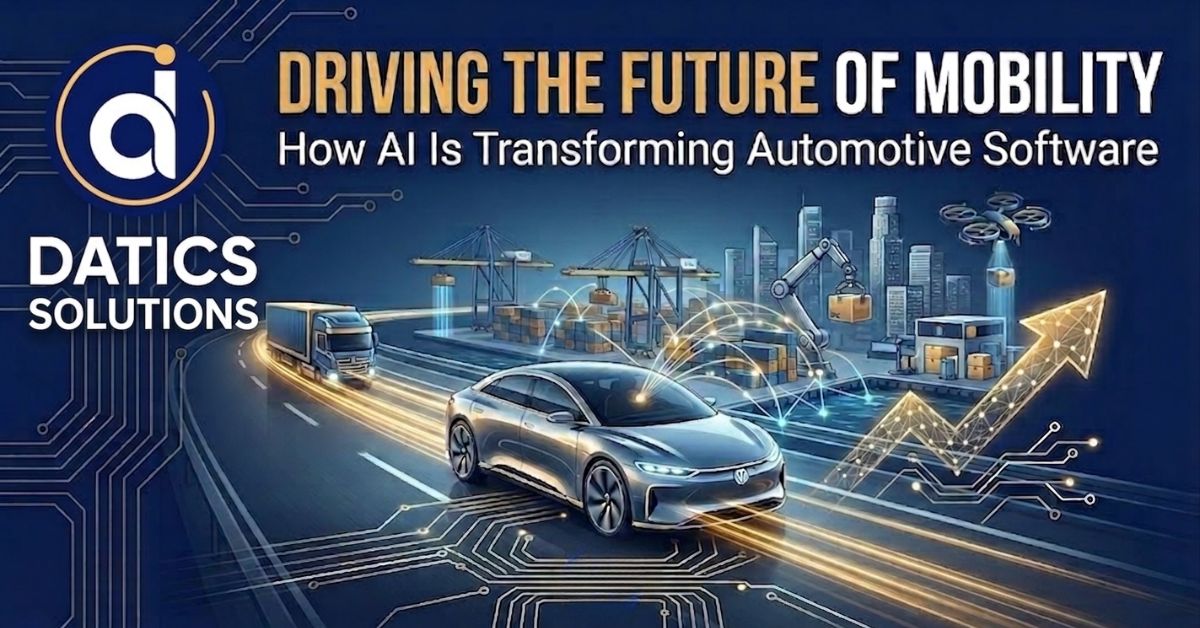
The global automotive landscape has shifted from a competition of horsepower to a battle of processing power. In 2026, the vehicle is no longer just a mechanical tool; it has evolved into a sophisticated, mobile data center. This transition is being led by a massive overhaul in automotive software development company in the USA, where static code is being replaced by dynamic, AI-driven architectures that allow cars to learn, adapt, and communicate with the world around them.
For businesses and manufacturers in the USA, this digital metamorphosis is a prerequisite for survival. As the industry moves toward Software-Defined Vehicles (SDVs), the value of a car is increasingly tied to its ability to receive over-the-air (OTA) updates that improve safety, performance, and the user experience long after it leaves the dealership.
The Shift to Software-Defined Vehicles (SDVs)
Historically, a car’s features were locked at the point of manufacture. If you wanted better fuel efficiency or a smarter dashboard, you had to buy a newer model. Today, AI-powered systems have decoupled hardware from software, allowing for a “living” vehicle. This means a car’s braking distance can be shortened, its battery range extended, or its navigation system improved through a simple software patch.
This shift requires a radical change in development philosophy. Instead of building isolated electronic control units (ECUs), engineers are now designing centralized “supercomputers” on wheels. Working with a dedicated automotive software development company in the USA allows manufacturers to navigate this complexity, ensuring that these centralized systems are both secure and scalable. At Datics Solutions LLC, we emphasize that the modern cockpit is an immersive digital space where AI understands driver intent through voice, gesture, and even biometrics.
AI-Enhanced ADAS and the Road to Autonomy
Advanced Driver Assistance Systems (ADAS) have moved beyond simple lane-keep warnings. In 2026, AI algorithms are processing millions of data points per second from LiDAR, radar, and cameras to perform “sensor fusion.” This allows the vehicle to build a 360-degree, high-definition map of its surroundings in real-time, identifying hazards and predicting the movements of pedestrians or other vehicles with superhuman precision.
These systems are the building blocks of SAE Level 3 and Level 4 autonomy. By utilizing deep learning, modern automotive software can handle “edge cases” and complex scenarios like navigating a construction zone or responding to unpredictable weather that once baffled traditional programming. This intelligence doesn’t just make driving more convenient; it is fundamentally designed to eliminate the 94% of accidents caused by human error.
Predictive Maintenance and EV Battery Optimization
For fleet owners and individual drivers alike, the “check engine” light is becoming obsolete. AI-driven predictive maintenance monitors telemetry data, vibration patterns, temperature fluctuations, and oil viscosity to forecast component failure weeks before it occurs. This proactive approach reduces unplanned downtime by up to 50%, a critical metric for commercial logistics and ride-sharing services.
In the electric vehicle (EV) sector, software is the key to solving “range anxiety.” AI algorithms optimize the thermal management of battery packs and predict the most efficient charging schedules based on ambient temperature and usage history. By managing the chemical stress on cells through intelligent software control, manufacturers are extending EV battery lifespans by 15-20%, directly improving the long-term ROI of the vehicle.
Edge AI and the Convergence of Connectivity
The future of mobility relies on the vehicle’s ability to “talk” to everything. Vehicle-to-Everything (V2X) communication allows cars to receive alerts from traffic lights about upcoming changes or from other vehicles about a sudden stop three cars ahead. To handle this massive influx of data without the delay of the cloud, “Edge AI” is now being deployed within the vehicle itself.
Edge computing processes data locally, enabling instant decision-making for safety-critical functions like pedestrian detection. This localized intelligence, combined with 5G connectivity, creates a seamless transit ecosystem where traffic flows more smoothly, and congestion is minimized through collaborative AI routing. As the automotive cockpit converges with consumer electronics, the vehicle becomes an extension of the user’s digital life, safe, connected, and infinitely upgradable.
Frequently Asked Questions
What exactly is a “Software-Defined Vehicle” (SDV)?
A software-defined vehicle is a car where the majority of its features and functions are managed and enabled through software rather than hardware. This architecture allows the vehicle to be upgraded over time via over-the-air (OTA) updates, much like a smartphone. It enables manufacturers to add new safety features, improve engine performance, or update infotainment systems without the customer ever needing to visit a physical service center.
How does AI improve the safety of automotive software systems?
AI enhances safety through Advanced Driver Assistance Systems (ADAS) that use machine learning to “see” and interpret the environment. By processing data from various sensors, the software can detect hazards, read traffic signs, and monitor driver alertness. Because AI can react in milliseconds, far faster than a human, it can execute emergency braking or evasive steering to prevent collisions that would otherwise be unavoidable.
Why is predictive maintenance becoming a standard feature in 2026?
Predictive maintenance uses AI to analyze real-time telemetry from the vehicle’s sensors to detect early signs of wear and tear. Instead of following a rigid schedule (like changing oil every 5,000 miles), the software tells you exactly when a part needs attention based on your actual driving behavior. This prevents “catastrophic failures” on the road, saves money by avoiding unnecessary service, and extends the overall lifespan of the vehicle’s mechanical components.
Does automotive software help in extending the range of electric vehicles (EVs)?
Yes, software is the primary tool for EV efficiency. AI-powered Battery Management Systems (BMS) monitor the health and temperature of each cell, optimizing how power is drawn and recharged. Software also manages “regenerative braking” and adjusts cabin climate control more intelligently. By analyzing driving routes and weather, the software can provide more accurate range forecasts and suggest the most energy-efficient driving modes, adding significant miles to a single charge.
How is the security of these highly connected vehicles managed?
Security is a foundational element of modern automotive software. Developers implement multi-layered cybersecurity frameworks, including end-to-end encryption for V2X communication and “secure gateways” that isolate critical driving functions from the infotainment system. Continuous vulnerability monitoring and over-the-air security patches ensure that the vehicle’s defenses evolve alongside emerging digital threats, keeping both the car and user data safe.