

Automation is no longer a future concept reserved for large enterprises. Modern businesses encounter automation decisions early, often before they realize they are making them. Understanding the difference between AI automation and rule-based automation helps beginners make smarter choices before complexity grows.
Many automation failures happen not because technology is wrong, but because the wrong type of automation is applied at the wrong time. This guide explains how both approaches work, when each makes sense, and how businesses can avoid costly missteps.
What Is Business Automation and How Does It Work?
Business automation refers to using technology to perform repetitive or predictable tasks without continuous manual effort. These tasks can include data handling, system coordination, approvals, reporting, or process execution across teams.
Automation works by translating business logic into executable workflows. Once defined, those workflows operate consistently, reducing reliance on human memory and manual intervention. This foundation is explained in more depth in What Is Business Automation, which outlines how automation supports operational stability as companies grow.
Most businesses begin their automation journey with structured processes before exploring more advanced approaches.
AI Automation vs Rule-Based Automation: What’s the Difference?
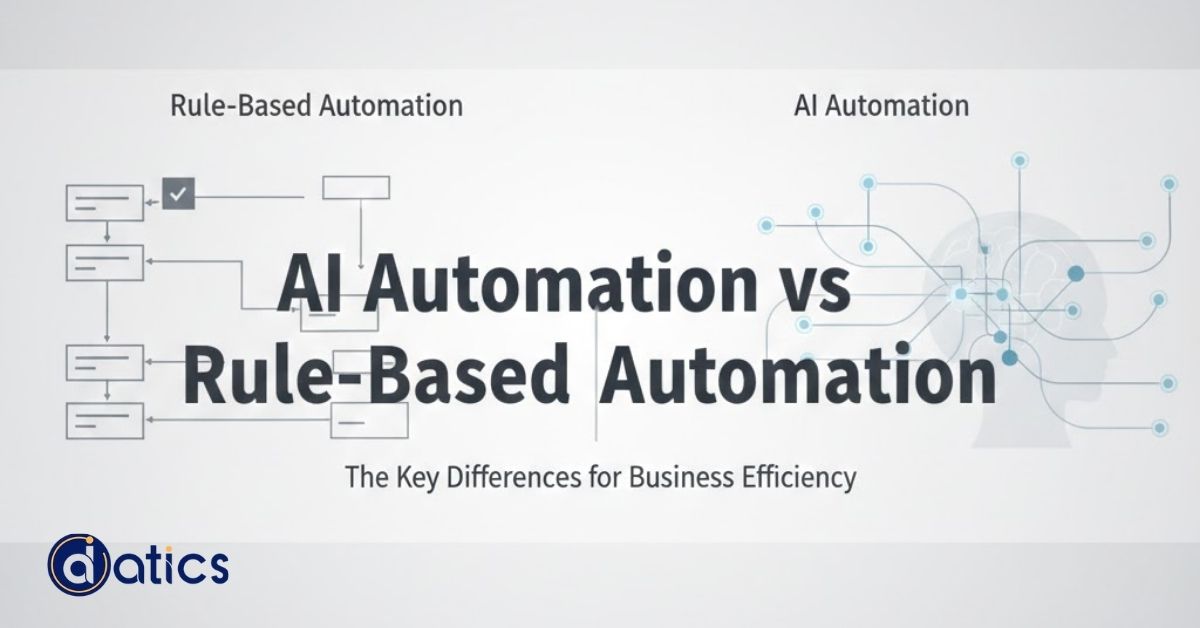
Rule-based automation follows explicit instructions. When a defined condition is met, a specific action occurs. This type of automation is reliable, predictable, and easy to audit. It works best for stable processes where outcomes are known in advance.
AI automation operates differently. Instead of relying only on fixed rules, AI systems analyze data, recognize patterns, and adjust behavior over time. This allows automation to handle variability, ambiguity, and evolving inputs that rule-based systems struggle with.
For beginners, the key distinction is control versus adaptability. Rule-based automation prioritizes consistency. AI automation prioritizes learning. Understanding this difference prevents unrealistic expectations and reduces the risk of overengineering early systems.
Common Automation Challenges Growing Businesses Face
One of the most common challenges is attempting AI automation before processes are clearly defined. Without structure, AI systems lack meaningful data to learn from, leading to unreliable outcomes.
Another challenge is assuming automation must be intelligent to be valuable. In reality, many businesses gain immediate benefits from simple rule-based automation long before AI becomes necessary.
These challenges highlight why automation decisions should be guided by operational clarity rather than trends or pressure.
How Automation Reduces Operational Costs Without Increasing Headcount
Automation reduces costs by eliminating repetitive manual work that consumes time without creating proportional value. When systems handle routine execution, teams can focus on problem-solving, customer experience, and strategic planning.
Automation also minimizes errors that lead to rework, delays, and inefficiencies. Consistent execution improves reliability across operations, allowing businesses to scale output without scaling staff.
This efficiency is one of the primary reasons companies invest in Automation services as part of long-term operational planning rather than short-term fixes.
When Businesses Should Invest in Automation Services
Businesses should consider automation when workflows repeat, coordination becomes complex, or growth starts creating operational strain. Automation is most effective when introduced intentionally, not reactively.
Early automation investments help companies avoid bottlenecks that limit scalability later. Waiting until systems are overwhelmed often results in rushed implementations that are difficult to maintain.
Organizations like Datics Solutions LLC emphasize aligning automation with business readiness rather than forcing advanced solutions too early.
Choosing the Right Automation Approach for Long-Term Growth
There is no universal answer to whether AI automation or rule-based automation is better. The right choice depends on process maturity, data availability, and business goals.
Rule-based automation provides a strong foundation. AI automation builds on that foundation when adaptability becomes essential. Understanding this progression allows businesses to grow automation capabilities without sacrificing control or clarity.
Automation succeeds when it evolves alongside the business rather than attempting to replace structure with intelligence prematurely.
Conclusion
AI automation and rule-based automation serve different purposes, but both play important roles in modern business operations. Beginners benefit most from understanding how each approach works and when it should be applied.
Automation is not about choosing the most advanced technology. It is about choosing the most appropriate one. When businesses align automation strategy with operational clarity, automation becomes a stabilizing force instead of a source of complexity.
FAQs
What is the main difference between AI automation and rule-based automation?
Rule-based automation follows predefined rules, while AI automation adapts using data and patterns.
Is AI automation better than rule-based automation?
Not always. Rule-based automation is often more effective for stable, predictable processes.
Can small businesses use AI automation?
Yes, but only after processes are clearly defined and sufficient data is available.
Which automation should beginners start with?
Most beginners should start with rule-based automation before exploring AI-driven systems.
Does automation reduce the need for employees?
Automation reduces repetitive work, allowing employees to focus on higher-value tasks.