

Every business today wrestles with problems that don’t have straightforward answers. Think of:
- Banks dealing with millions of fraud attempts daily.
- Hospitals flooded with patient data that doctors can’t manually analyze fast enough.
- Retailers needing to predict demand when customer behavior changes overnight.
Traditional software often collapses under this weight. It works in silos, solves one part of the problem, and struggles to scale. This is where AI software development comes in—not as a buzzword, but as a practical framework for building solutions that actually grow with the problem.

From Complexity to Clarity: What AI Really Does
AI software doesn’t just “automate.” It learns. It adjusts. It uncovers patterns humans might miss.
- In healthcare, AI scans thousands of medical images in seconds, flagging anomalies doctors might overlook.
- In logistics, AI predicts traffic and weather disruptions, rerouting shipments in real time.
- In education, AI tailors lessons to how fast or slow each student learns, making teaching scalable.
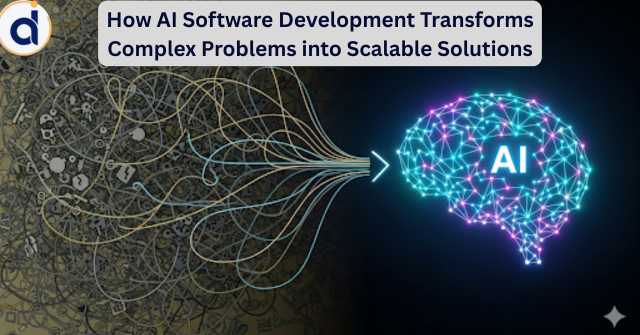
It takes chaos (complexity) and turns it into clarity (scalable insight and action).
The Core Ways AI Software Development Solves Problems
1. It Turns Data Into Decisions
Every organization drowns in data. AI transforms that flood into actionable decisions—whether it’s spotting fraudulent transactions in milliseconds or recommending the right product to a customer.
2. It Automates Without Losing Human Value
AI doesn’t replace human talent—it removes repetitive tasks so people can focus on creative, strategic work.
3. It Scales Without Breaking
Whether a SaaS platform grows from 1,000 to 1 million users, or a healthcare system adds hundreds of hospitals, AI ensures systems stay reliable.
4. It Learns as It Goes
Unlike traditional systems that need manual updates, AI improves with use. The more it processes, the better it gets at solving problems.
Real-World Scenarios Where AI Makes the Difference
- Fraud Prevention: Payment platforms use AI to process millions of transactions, learning patterns of fraud in real time. Without AI, detection would be too slow.
- Smart Education: Universities adopt AI tools to blend with LMS systems, making digital classrooms adaptive. (See: How AI Education Software Integrates with Existing LMS Effectively).
- Customer Support at Scale: AI chatbots now resolve 80% of first-level queries, freeing human agents to handle the tough conversations.
These aren’t “future” examples—they’re happening now.
The Challenges (And How AI Overcomes Them)
- Data Privacy & Trust
– Solution: AI development now embeds encryption, GDPR compliance, and secure architectures by design. - Integration with Old Systems
– Solution: APIs and middleware allow AI tools to fit into existing workflows without requiring full rebuilds. - The Talent Gap
– Solution: Partnering with experienced AI teams bridges the skills shortage, making implementation smoother. - High Upfront Costs
– Solution: Cloud-based AI services let companies start small and scale only when value is proven.
Why Scalability Matters Most
The real win with AI isn’t just solving problems—it’s solving them again and again at scale.
- A hospital system doesn’t need one diagnosis tool for one clinic. It needs a scalable solution across 200 clinics.
- A SaaS startup doesn’t need a chatbot for 100 users. It needs one that can handle 100,000 without breaking.
That’s the difference between AI and traditional software—one grows with you, the other falls behind.
Looking Ahead: AI as a Problem-Solving Partner
We’re moving toward a world where AI isn’t “added on” to software—it’s the foundation. Future AI development will:
- Model climate change at city-wide scales.
- Enable personalized medicine for every individual.
- Run smart cities with adaptive traffic and energy systems.
Companies like Datics.ai are already helping organizations prepare for this future by building AI software development solutions that don’t just meet today’s needs but are designed to scale with tomorrow’s challenges. AI will continue to be less about “technology for technology’s sake” and more about solving the pressing human problems that matter most.
FAQs
1. What is AI software development in simple terms?
It’s the process of building software that learns and adapts to solve problems more effectively over time.
2. Why is scalability important in AI solutions?
Because problems grow—AI ensures the solution grows with them.
3. Can small businesses use AI software?
Yes. Cloud-based AI makes it affordable for startups and SMEs to adopt AI at their scale.
4. What’s the biggest barrier to AI adoption?
Integration with existing systems, which is now easier thanks to modern APIs.
5. How is AI different from traditional software?
Traditional software follows rules; AI software learns patterns and evolves.