

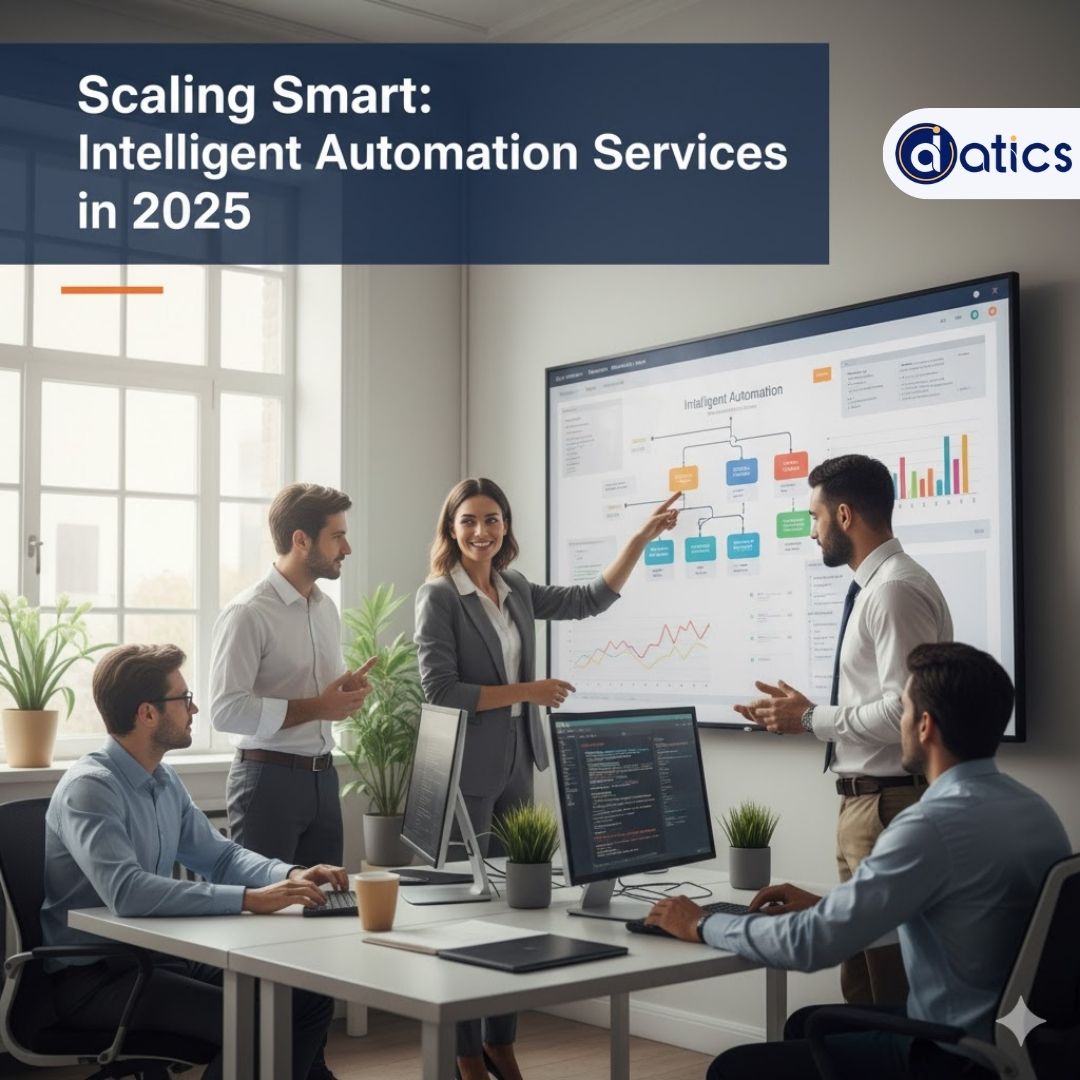
Scaling an enterprise has always been a balancing act — growth brings opportunity, but it also invites complexity. In 2025, that complexity has reached new levels with hybrid workforces, cloud ecosystems, and data-driven operations. To scale efficiently without losing control, more organizations are embracing Intelligent Automation Services — a modern blend of AI, robotic process automation (RPA), and data analytics that redefines operational excellence.
Rather than simply automating repetitive tasks, intelligent automation empowers enterprises to grow smarter, integrating AI into the heart of decision-making, compliance, and customer experience. Companies like Datics.ai are helping organizations build automation ecosystems that evolve as they scale — ensuring growth never turns into chaos.
Understanding Intelligent Automation
Intelligent Automation (IA) goes beyond traditional automation. While earlier solutions focused on fixed rules and repetitive tasks, IA combines machine learning, natural language processing, and data orchestration to automate complex processes that require reasoning and adaptability.
In essence, IA gives software the ability to think, learn, and decide allowing enterprises to operate with the precision of machines and the insight of human intelligence.

The Scaling Challenge: Why Automation Matters
As businesses expand, so do workflows, customer interactions, and data streams. Manual management becomes inefficient and prone to errors. Common scaling challenges include:
- Inconsistent service quality across departments
- Increased operational bottlenecks
- Data silos between teams and tools
- Rising compliance and reporting demands
- Higher employee burnout due to workload overload
This is where Intelligent Automation Services step in — not as a patch, but as a strategic framework to unify technology, people, and processes.
How Intelligent Automation Services Enable Scalable Growth
1. Streamlining Complex Workflows
Intelligent automation integrates multiple enterprise systems — CRM, ERP, HR, and finance — into a cohesive, data-driven network. Processes once handled manually now flow seamlessly between departments, reducing handoffs and delays.
2. Enhancing Decision-Making with AI Insights
AI algorithms within automation platforms continuously analyze data, detect anomalies, and recommend actions. This real-time intelligence helps leadership make faster, more informed decisions without waiting for manual reports.
3. Empowering Employees Instead of Replacing Them
Contrary to the myth that automation replaces human jobs, IA actually enhances employee productivity. Routine, time-consuming tasks are automated so employees can focus on creative, strategic, and customer-centric initiatives.
4. Reducing Operational Errors
Automation ensures that processes follow strict logical rules, drastically minimizing human errors in finance, logistics, and data entry maintaining consistency as organizations expand.
5. Ensuring Compliance and Governance
As businesses grow, compliance tracking becomes complex. Intelligent automation can monitor regulations, audit trails, and reporting requirements automatically — ensuring continuous governance without added administrative burden.
Automation in the Education Sector
Automation is not limited to tech-centric enterprises. In the education industry, for example, AI-based grading tools are reducing teacher workloads while maintaining fairness and accuracy.
As discussed in this Datics.ai blog, automation allows educators to streamline grading, feedback, and reporting enabling institutions to scale academic programs without increasing administrative strain.
This principle translates directly into enterprise scaling: automation removes manual bottlenecks so teams can focus on impact, not paperwork.
Key Benefits of Intelligent Automation Services
- Scalable Infrastructure: Automate once, and scale infinitely with minimal reconfiguration.
- Enhanced Agility: Respond instantly to market changes with adaptive workflows.
- Improved Accuracy: Data-driven processes eliminate guesswork and duplication.
- Cost Efficiency: Reduced manual effort translates to significant operational savings.
- Innovation Enablement: Teams are free to innovate rather than maintain outdated systems.
Datics.ai’s Approach to Intelligent Automation
At Datics.ai, automation isn’t treated as a one-time deployment it’s a continuous transformation journey. The company helps enterprises identify automation opportunities, integrate AI models, and design scalable frameworks that evolve with business goals.
By focusing on transparency, scalability, and adaptability, Datics.ai ensures that every automation solution not only improves efficiency but also prepares enterprises for the next wave of digital innovation.
Avoiding Chaos During Rapid Growth
Automation can sometimes magnify inefficiencies if implemented without strategy. To ensure smooth scaling:
- Start with a process audit to identify automation-ready tasks.
- Implement modular automation that can expand easily
- Integrate AI gradually, aligning technology with existing workflows.
- Foster a human-automation collaboration model — training teams to work with AI tools effectively.
These steps transform automation from a tool into a scaling enabler, keeping operations organized, data clean, and decisions aligned with long-term strategy.
The Future of Scaling with Intelligent Automation
By 2025, more than 70% of enterprises will rely on AI-powered automation to manage operations, customer experiences, and supply chains. Intelligent Automation Services have become the silent engine behind business agility — enabling companies to expand globally, serve more customers, and innovate faster without adding layers of chaos.
In the years ahead, the most successful enterprises will be those that recognize automation not as a shortcut but as a strategic capability one that connects intelligence, efficiency, and human creativity into a single ecosystem.
FAQs
1. What are Intelligent Automation Services?
They combine AI, RPA, and data analytics to automate complex business processes intelligently and efficiently.
2. How do they help enterprises scale?
They unify data, streamline workflows, and automate decision-making — enabling faster, error-free growth.
3. Are Intelligent Automation Services suitable for all industries?
Yes. From healthcare to finance to education, automation adapts to any workflow with measurable ROI.
4. What’s the ROI timeline for automation adoption?
Most enterprises see productivity and cost-savings gains within 6 to 12 months of deployment.
5. How does Datics.ai support automation?
Datics.ai provides customized automation solutions built on scalable AI frameworks that evolve with your business.
Author Bio
Written by the editorial team at Datics.ai — a trusted partner in AI software and automation innovation. Datics.ai empowers global enterprises with scalable Intelligent Automation Services, transforming complex workflows into seamless, data-driven operations that fuel sustainable growth.