

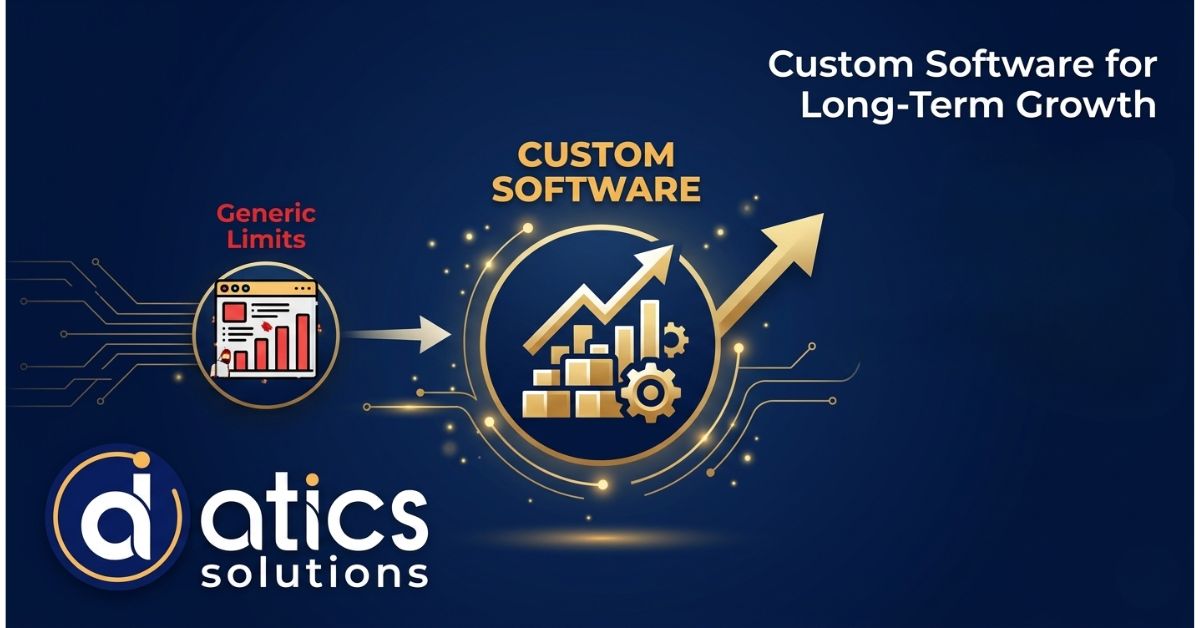
In the hyper-competitive landscape of 2026, the traditional “buy vs. build” debate has shifted. For many growing enterprises, off-the-shelf solutions, once the standard for speed, have become a bottleneck. As markets fragment and consumer expectations for personalization skyrocket, custom software development has emerged not just as a technical preference but as a core pillar of long-term business strategy.
A simple reality drives the shift toward bespoke technology: your business is unique. Generic software forces you to mold your unique workflows into a rigid, predetermined box. Conversely, tailored solutions are built to wrap around your specific operations, allowing you to scale without the friction of “software debt.”
Eliminating the “Subscription Tax” and Scaling Predictably
One of the most immediate benefits of choosing to build over buy is the financial clarity it provides. While commercial off-the-shelf (COTS) software often boasts a lower entry price, the long-term cost of ownership can be deceptive. Between per-user licensing fees, mandatory “pro” tier upgrades, and the cost of third-party integrations, many companies find themselves paying a “subscription tax” that scales faster than their revenue.
With custom software solutions, you shift from a recurring expense to a capital asset. Once the initial development is complete, you own the intellectual property. This ownership allows you to add as many users or process as much data as needed without worrying about a surprise invoice from a vendor. Furthermore, by working with a specialized custom software development company in USA, businesses ensure their architecture is designed for “horizontal scaling”—the ability to add capacity seamlessly as demand grows.
Seamless Integration and Data Sovereignty
In a modern enterprise, data is the most valuable currency. However, many ready-made tools trap that data in silos, making it difficult to get a 360-degree view of your operations. This lack of integration leads to manual data entry, human error, and delayed decision-making.
Custom software development prioritizes an API-first approach, ensuring that your new platform communicates fluently with your existing ERP, CRM, and legacy databases. This connectivity enables real-time analytics and automated reporting that generic tools simply can’t match. Perhaps more importantly, custom systems offer superior data sovereignty. In an era of tightening regulations like GDPR and various state-level privacy laws, owning your data pipeline allows you to implement “security-by-design” measures that are specifically tuned to your industry’s compliance requirements.
Competitive Differentiation Through Innovation
When you use the same software as your competitors, you are essentially using the same playbook. It is difficult to innovate when your digital tools have the same limitations as everyone else in the market. Bespoke applications allow you to build proprietary features such as unique customer portals, specialized AI-driven recommendation engines, or automated logistics workflows that become part of your unique value proposition.
At Datics Solutions LLC, we have seen that the most successful digital transformations happen when a company uses technology to enhance its “secret sauce.” Whether it’s a specialized algorithm for a fintech startup or a unique inventory tracking system for a global manufacturer, custom code acts as a force multiplier for your existing strengths. It turns your software from a cost center into a primary driver of market share.
Is Your Business Ready for Custom Development?
While the benefits are significant, the transition to custom systems requires a mindset shift. It is an investment in the next five to ten years of your company’s life. If your current software feels like a hurdle rather than a tool, or if you are spending more time managing workarounds than serving customers, it is a clear signal that your growth has outpaced your infrastructure.
| Feature | Off-the-Shelf Software | Custom Software Development |
| Upfront Cost | Low to Moderate | Higher Initial Investment |
| Long-term Value | High (ongoing fees) | High (asset ownership) |
| Scalability | Limited by Vendor Tiers | Theoretically Infinite |
| Integration | Rigid / Plugin-dependent | Native & Seamless |
| Competitive Edge | Commodity (Same as others) | Proprietary (Unique to you) |
Frequently Asked Questions
Is custom software always more expensive than a ready-made solution in the long run?
While the initial investment for custom software development is typically higher, the total cost of ownership (TCO) often equals it within three to five years. Ready-made software involves recurring licensing fees that grow as your team expands, plus the “hidden costs” of inefficiency when the software doesn’t perfectly fit your workflow. Over a decade, owning your software is frequently 30–50% cheaper than paying per-seat licenses for a generic platform that requires constant workarounds.
How long does it typically take to see a return on investment (ROI) from custom software?
Most businesses begin seeing an ROI through increased operational efficiency and reduced manual labor within the first 6-12 months post-launch. However, the “strategic ROI,” such as the ability to launch new product lines or handle 10x the order volume without hiring more staff often manifests in the second year. By automating unique business processes that generic tools ignore, you recoup the development costs through sustained productivity gains and the elimination of expensive subscription tiers.
Can I integrate my custom-built software with my existing tools like QuickBooks or Salesforce?
Absolutely. One of the primary advantages of bespoke development is that it is built specifically to connect with your existing tech stack. Developers use APIs (Application Programming Interfaces) to create “bridges” between your new software and your current tools. This ensures that data flows automatically between departments, eliminating the need for double data entry and providing your leadership team with a “single source of truth” for all business metrics.
How do I maintain and update custom software after it has been built?
Post-launch maintenance is handled through a structured support and maintenance agreement. Unlike generic software, where you wait for the vendor to release an update you may or may not need, you control your own roadmap. You can choose to add new features, update security protocols, or optimize performance whenever your business needs change. This level of control ensures that your technology evolves alongside your market, rather than becoming obsolete every few years.
What happens to my software if I decide to switch development partners in the future?
When you engage in professional custom software development, you own the source code. A reputable partner will provide clean, well-documented code and use standard frameworks that any qualified engineer can understand. This prevents “vendor lock-in,” giving you the freedom to move your project to an in-house team or a different agency if your needs change. Ownership of the intellectual property is the ultimate safeguard for your company’s long-term digital independence.