

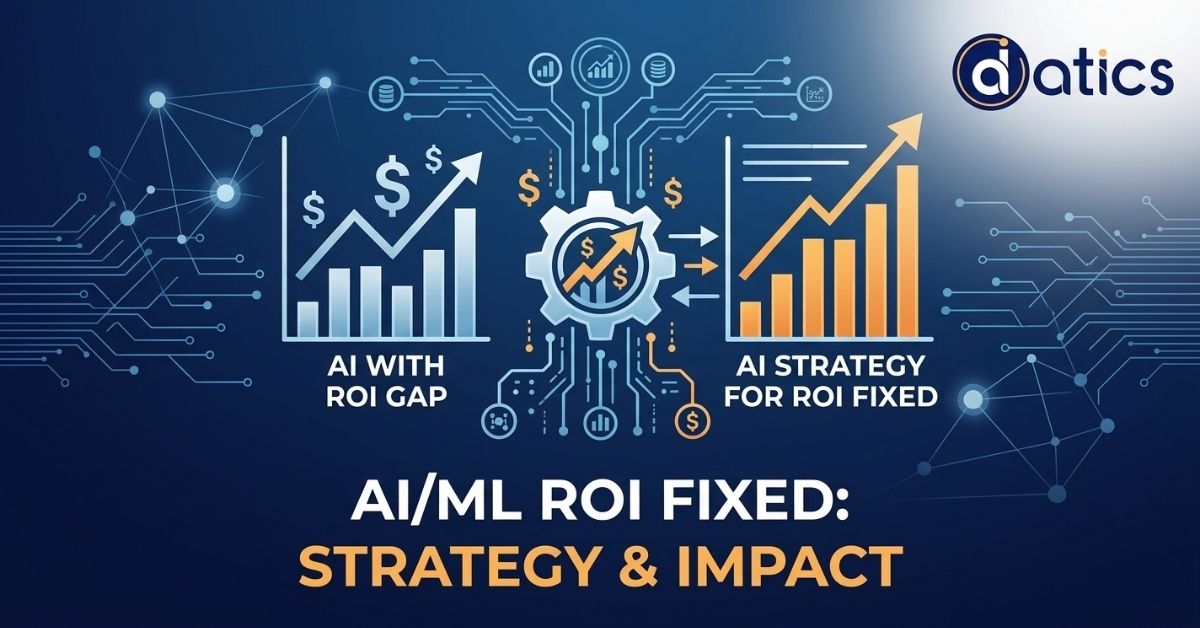
By 2026, the initial “hype cycle” of artificial intelligence has largely settled, leaving business leaders with a hard reality: simply having AI isn’t the same as profiting from it. Many organizations rushed into implementation over the last two years, only to find that their expensive models aren’t moving the needle on the bottom line. This disconnect—the ROI gap—is where the real work of AI Consulting begins.
Closing this gap requires moving away from experimental “plug-and-play” tools and toward a bespoke strategy that treats technology as a financial driver. If your current systems are underperforming, it is likely due to a lack of structural alignment between your data, your people, and your business goals.
Identifying the Hidden Bottlenecks in AI Adoption
The primary reason for stagnant ROI isn’t usually the technology itself; it is the environment in which the technology is placed. Companies often suffer from “siloed intelligence,” where a brilliant machine learning model is built by a technical team but never properly integrated into the actual daily workflows of the sales or operations departments.
A professional approach to artificial intelligence consulting starts with an audit of these integration points. Are your managers using the insights provided by the AI to make decisions, or is the data sitting in a dashboard that no one checks? When AI implementation services fail to deliver, it is often because the human element was overlooked. To fix the ROI gap, you must ensure that your intelligent automation solutions are designed to solve specific, measurable problems rather than just existing for the sake of innovation.
The Role of AI Strategy Consulting in Cost Recovery
If you find that your AI spend is outpacing your returns, you likely need a pivot in your AI strategy consulting framework. In 2026, the focus has shifted from “can we build it?” to “should we build it?” Strategic consulting helps businesses prune underperforming projects and double down on high-impact areas like predictive supply chain management or hyper-personalized customer retention.
By refining your AI adoption strategy, you can move toward data-driven decision making that actually lowers operational costs. For many USA-based firms, the key to success lies in partnering with an AI consulting company in USA that understands the local market dynamics and regulatory requirements. This localized expertise ensures that your strategy isn’t just theoretically sound but practically viable within your specific industry constraints.
Scaling with Precision: Business AI Solutions that Last
Scaling is often where the ROI gap widens into a chasm. A prototype that works for a small dataset may become prohibitively expensive or technically unstable when scaled to an entire enterprise. Fixing this requires a transition to more robust business AI solutions that prioritize efficiency and modularity.
Sustainable growth is built on machine learning integration that is “future-proof.” This means using architectures that can be easily updated as new models emerge without requiring a complete system overhaul. At Datics Solutions LLC, we emphasize that long-term value is created through business process automation that evolves. When your systems are designed to learn and adapt, the cost of maintenance drops while the value of the insights continues to rise, effectively closing the ROI gap over time.
Frequently Asked Questions
1. Why is our company’s AI ROI lower than expected despite high initial investment?
The most common cause for low ROI is a lack of alignment between the technical capabilities of the AI and the actual operational needs of the business. Often, companies invest in “off-the-shelf” solutions that don’t address their unique pain points or fail to integrate the AI output into the decision-making process of their staff. To fix this, you must conduct a thorough audit of your workflows to ensure the AI is removing specific friction points rather than adding another layer of complexity to your existing systems.
2. How does AI consulting help in reducing the long-term costs of technology?
AI consulting services provide a roadmap that prevents “expensive trial and error.” By identifying the right technology stack and architectural approach from the beginning, consultants help you avoid technical debt—the cost of fixing poorly designed systems later. Additionally, strategic consulting focuses on automating high-volume, low-value tasks, which directly reduces labor costs and allows your core team to focus on high-level strategic initiatives that drive revenue.
3. What should a beginner look for when choosing AI implementation services in 2026?
In the current market, you should look for service providers who emphasize “Transparency” and “Explainability.” It is no longer enough for an AI to give an answer; you need to know why it gave that answer to ensure it is accurate and unbiased. Look for consultants who offer a clear Proof of Concept (PoC) phase, have a strong track record of successful integrations in your specific industry, and prioritize data security and compliance as a core part of their development lifecycle.
4. Can AI strategy consulting help with data privacy and compliance in the USA?
Absolutely. With evolving regulations around data usage and consumer privacy, AI strategy consulting is essential for navigating the legal landscape. Consultants help implement “Privacy by Design” in your AI models, ensuring that you are using data ethically and legally. This not only protects your company from potential lawsuits and fines but also builds trust with your customers, which is a critical, though often overlooked, component of long-term ROI.
5. Is it better to build an in-house AI team or hire a consultancy?
For most mid-sized to large enterprises, a hybrid approach is most effective. Building an entire in-house team is slow and extremely expensive given the current talent shortage. Hiring a consultancy allows you to access high-level expertise immediately to set the strategy and build the core infrastructure. Once the system is stable, your smaller in-house team can manage the daily operations, allowing you to scale faster while keeping overhead costs under control.