

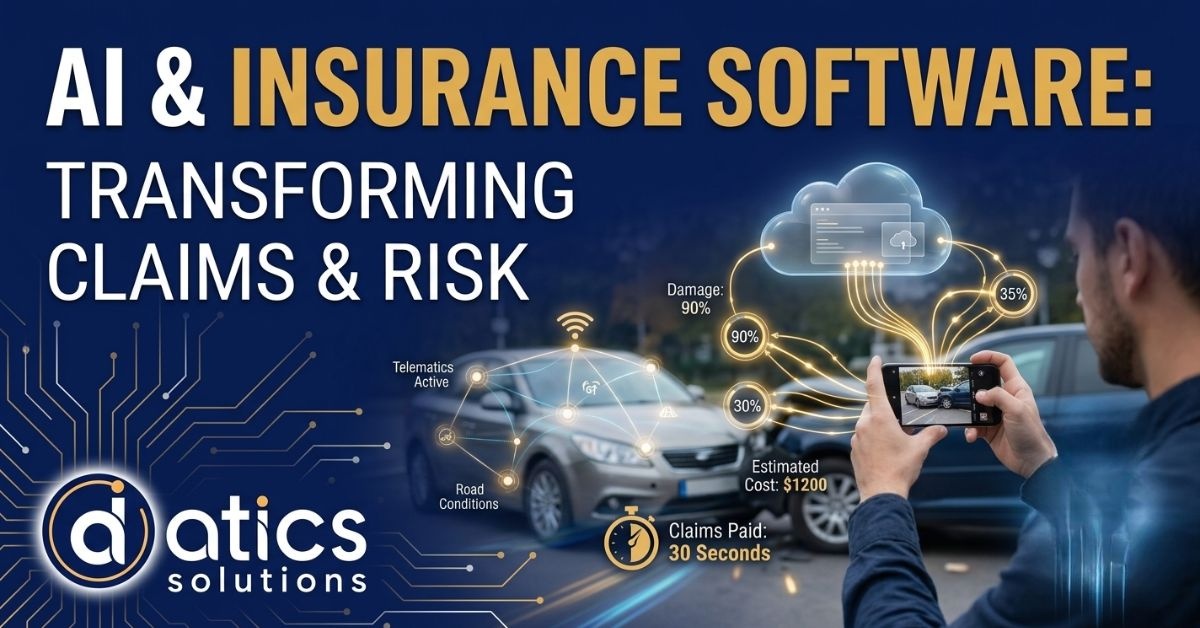
The American insurance landscape is currently navigating its most significant transformation in decades. In 2026, the industry has moved past the experimental phase of artificial intelligence, embedding it into the very core of operational strategy. For carriers, the focus has shifted from simple digitization to the deployment of insurance software development services that offer true predictive power.
This evolution is fundamentally changing the relationship between the insurer and the policyholder. No longer a reactive service that only appears after a loss, modern insurance is becoming a proactive partner in risk prevention. By utilizing real-time data and autonomous agents, insurance companies are not just processing claims faster, they are preventing them from happening in the first place.
The Era of Autonomous Claims: From Weeks to Seconds
Historically, the claims process has been the primary source of friction in the insurance lifecycle. The traditional manual triage of a “First Notice of Loss” (FNOL) often took days, followed by weeks of adjustments and paperwork. Today, AI-driven automation has condensed this timeline into mere minutes for standard claims.
Modern insurance platforms now utilize computer vision to assess vehicle or property damage through photos uploaded via a smartphone. These algorithms can instantly estimate repair costs by comparing images against millions of historical data points. When a claim falls under a specific financial threshold, the software can trigger a “straight-through processing” (STP) workflow, issuing payment to the policyholder’s digital wallet before they even leave the scene of the accident. This level of efficiency is only possible through a specialized insurance software development company in the USA that understands the nuances of local repair costs and state-specific regulatory requirements.
Redefining Risk: Real-Time Data and Predictive Underwriting
The “actuarial table” is being rewritten by the Internet of Things (IoT) and telematics. In 2026, risk is no longer a static number calculated once a year at renewal. Instead, insurance software provides “continuous underwriting,” where premiums can adjust dynamically based on real-time behavior and environmental data.
For commercial property insurance, sensors can detect early signs of water leaks or electrical surges, alerting the policyholder to take action before a catastrophic loss occurs. In the automotive sector, telematics data allows for “pay-how-you-drive” models that reward safety with lower premiums. At Datics Solutions LLC, we have seen that when software provides this level of granular visibility, it transforms the insurer from a silent biller into a vital safety consultant, significantly increasing long-term customer retention.
Fraud Detection in the Age of Graph Analytics
Insurance fraud costs US carriers billions annually, a burden that is ultimately passed down to honest policyholders through higher premiums. Traditional rule-based systems often struggled to identify sophisticated fraud rings or subtle anomalies. AI has turned the tide by utilizing “Graph Analytics” and anomaly detection to map relationships between claimants, witnesses, and medical providers.
These intelligent systems can surface suspicious patterns that would be invisible to a human eye, such as multiple claims involving the same set of individuals across different states. By identifying these “red flags” at the moment of FNOL, the software allows investigators to focus their energy on high-risk cases while legitimate claims move through the system without delay. This balance of speed and security is the hallmark of a mature digital insurance ecosystem.
Personalized Customer Experiences and Agentic Support
As we move deeper into 2026, the role of the “chatbot” has evolved into the “AI agent.” These agents are grounded in the carrier’s specific knowledge base, allowing them to answer complex questions about policy coverage, exclusions, and local regulations in natural language. If a policyholder is traveling, the software can proactively suggest temporary coverage adjustments based on their destination’s risk profile.
Furthermore, this intelligence extends to the human agents. “Agent copilots” assist underwriters by summarizing complex submissions, suggesting terms, and comparing risks against historical analogues. This doesn’t replace the expert’s judgment; it augments it, allowing them to process standard risks three times faster while dedicating their expertise to genuinely complex or high-stakes cases. The result is a more responsive, transparent, and human-centric insurance experience.
Frequently Asked Questions
1. How does AI improve the accuracy of damage estimation in property and auto insurance?
AI improves accuracy through a process called “computer vision,” where deep learning models are trained on millions of images of labeled damage. These models can distinguish between minor scratches that require buffing and structural damage that requires replacement. By comparing the visual evidence against real-time local parts databases and labor rates, the software generates a precise estimate that is often more consistent and less prone to human bias than a traditional manual inspection.
2. Is my personal data safe when used for telematics and real-time risk assessment?
Data security is the highest priority for insurance software development services in 2026. Systems are built using “Privacy-Enhancing Technologies” (PETs) and end-to-end encryption. In many cases, the raw data (like your specific GPS coordinates) is processed “at the edge” on your device, and only the resulting safety score is sent to the insurer. This allows the carrier to provide discounts based on your safety without ever actually knowing your exact daily routine.
3. Will AI-driven claims processing lead to more rejected claims?
Actually, the goal of AI in claims is transparency and consistency. Because the software follows a standardized logic grounded in the specific language of your policy, it ensures that every claimant is treated fairly according to the same rules. Furthermore, many systems now include “Explainable AI” features that can provide a policyholder with a clear, step-by-step breakdown of why a specific decision was made, reducing confusion and the need for stressful appeals.
4. How does AI help in detecting organized insurance fraud rings?
AI uses “Graph Analytics” to look at the connections between data points rather than just the data points themselves. For example, it might notice that a claimant in one city and a witness in another both shared a phone number or a bank account three years ago. By mapping these hidden networks, the software can flag potential “staged accidents” or organized rings that are intentionally manipulating the system, allowing the insurer to stop the fraud before payment is issued.
5. How long does it typically take for a carrier to implement a new AI-powered claims platform?
Implementation times have dropped significantly since 2022. While a full replacement of a 30-year-old legacy system can still take 18 to 24 months, most modern carriers use a “modular” approach. By integrating AI-driven modules for specific tasks like FNOL triage or fraud detection, insurers can see a measurable ROI within 6 to 9 months. This progressive modernization allows the company to improve its service without the risk of a “big bang” system failure.